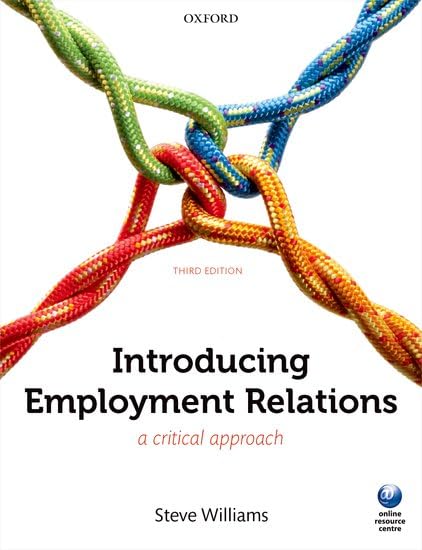
Introducing employment relations : a critical approach / Steve Williams
Publication details: Oxford : Oxford University Press, c2014. Edition: 3rd edDescription: xxvi, 394 p. : ill. ; 25 cmISBN: 9780199645497Subject(s): Industrial relations -- Great Britain | Industrial relations | Labor unions -- Great Britain | Labor contract -- Great Britain | Contract labor | Personnel management | Labor contractDDC classification: 658.315 WIL| Item type | Current library | Home library | Call number | Status | Date due | Barcode | Item holds |
|---|---|---|---|---|---|---|---|
 English Lending
|
Villa College Library | Villa College Library | 658.315 WIL (Browse shelf(Opens below)) | Available | 9034 | ||
 English Reference
|
Villa College Library | Villa College Library | 658.315 WIL (Browse shelf(Opens below)) | Available | 8855 | ||
|
English Lending
|
Villa College Library | Villa College Library | 658.315 WIL (Browse shelf(Opens below)) | In transit from Villa College QI Campus to Villa College Library since 05/26/2022 | 9032 | ||
|
English Lending
|
Villa College Library | Villa College Library | 658.315 WIL (Browse shelf(Opens below)) | Available | 9033 |
CONTENT INCLUDES:
Part 1 Introducing employment relations
1.The nature of employment relations
1.1.Introduction
Introductory case study: The relevance of employment relations
1.2.The employment relationship and employment relations
1.3.Employment relations as a `field of study'
1.4.Employment relations: actors, processes, outcomes, and contexts
1.5.Conclusion: the value of employment relations
Assignment and discussion questions
Chapter case study: Employment relations in Amazon
Part 2 Employment relations in context
2.Employment relations in the contemporary economy
2.1.Introduction
Introductory case study: Agency workers and employment flexibility
2.2.Work and employment relations: from the `new economy' to recession
2.3.Employment relations in a global economy
2.4.Conclusion
Chapter case study: The effectiveness of voluntary labour codes
Contents note continued:
3.The politics of employment relations
3.1.Introduction
Introductory case study: The European Union's Agency Workers Directive
3.2.Public policy and employment relations
3.3.Labour and employment relations in Britain, 1997-2010
3.4.The coalition government's policy approach in employment relations
3.5.Employment relations and the politics of European integration
3.6.Conclusion
Chapter case study: The Irish Ferries dispute
4.Social divisions and employment relations
4.1.Introduction
Introductory case study: Pregnancy discrimination at work
4.2.Discrimination, disadvantage, and inequality in work and employment relations
4.3.Public policy, anti-discrimination legislation, and equality at work
4.4.Equality and diversity at work
4.5.Conclusion
Chapter case study: Equal pay in local government
unions v lawyers
Part 3 Key issues in contemporary employment relations
5.Managing employment relations
5.1.Introduction
Introductory case study: Engaging employees at McDonalds
5.2.Managing with trade unions
5.3.Challenging unions
5.4.Sophisticated human resource management and employment relations
5.5.Conceptualizing the management of employment relations
5.6.Conclusion
Chapter case study: Blacklisting trade unionists in the construction industry
6.Representation at work
6.1.Introduction
Introductory case study: Organizing workers in a sandwich factory
6.2.Trade unions, worker representation, and the `representation gap'
6.3.Non-union forms of employee representation
6.4.Cooperative trade unionism and partnership agreements
6.5.Organizing unionism
6.6.Conclusion
Chapter case study: Community unionism
Contents note continued: 7.Pay determination and employment relations
7.1.Introduction
Introductory case study: The `fair tips' campaign
7.2.Collective bargaining and pay determination
7.3.Unilateral managerial regulation of pay
7.4.Regulating low pay
7.5.Conclusion
Chapter case study: Campaigning for fair pay in supermarkets
8.Working time and employment relations
8.1.Introduction
Introductory case study: Overtime bans on the railways
8.2.Working time and employment relations
8.3.Working time: patterns and trends
8.4.Work pressures and work intensification
8.5.The legal regulation of working time
8.6.Conclusion
Chapter case study: Junior doctors and the Working Time Directive
Part 4 Conflict and employment relations
9.Labour conflict and employment relations
9.1.Introduction
Introductory case study: The 2012 pensions strikes at Unilever
Contents note continued: 9.2.The nature and purpose of strikes
9.3.Strike trends
9.4.The legal regulation of strikes and industrial action
9.5.Understanding labour conflict: insights from mobilization theory
9.6.Other forms of labour conflict
9.7.Conclusion
Chapter case study: The BA cabin crew dispute 2009-11
10.Resolving labour conflict
10.1.Introduction
Introductory case study: Redundancy compensation for Woolworths ex-staff
10.2.Resolving collective disputes
10.3.Resolving individual disputes: grievance and discipline in employment relations
10.4.Redundancy and employment relations
10.5.The system of employment tribunals
10.6.Conclusion
Chapter case study: Enforcing employment rights
Part 5 Conclusion
11.Conclusion.
Includes bibliographical references and index.
Click on an image to view it in the image viewer
There are no comments on this title.