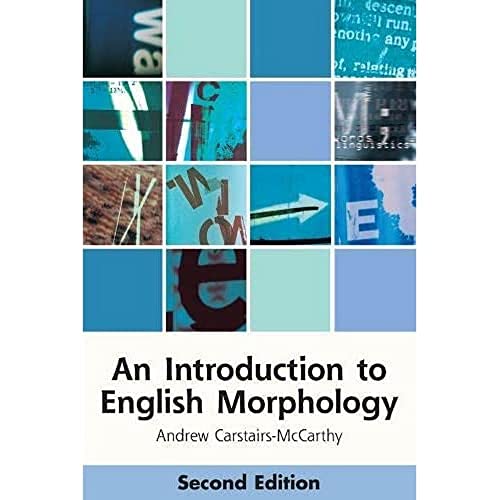
An introduction to English morphology : words and their structure / Andrew Carstairs-McCarthy
Publication details: Edinburgh : University Press , c2018. Edition: 2nd edDescription: viii, 151 p. : ill. ; 22 cmISBN: 9781474428972Subject(s): English language -- Morphology | | DDC classification: 425 CAR| Item type | Current library | Home library | Call number | Status | Date due | Barcode | Item holds |
|---|---|---|---|---|---|---|---|
 English Lending
|
Villa College QI Campus | Villa College Library | 425 CAR (Browse shelf(Opens below)) | In transit from Villa College QI Campus to Villa College Library since 05/10/2022 | 13765 |
Browsing Villa College Library shelves Close shelf browser (Hides shelf browser)


Machine generated contents note:
1.Introduction
Recommendations for reading
2.Words, sentences and dictionaries
2.1.Words as meaningful building-blocks of language
2.2.Words as types and words as tokens
2.3.Words with predictable meanings
2.4.Non-words with unpredictable meanings
2.5.Conclusion: words versus lexical items
Technical terms
Exercises
3.A word and its parts: roots, affixes and their shapes
3.1.Taking words apart
3.2.Kinds of morpheme: bound versus free
3.3.Kinds of morpheme: root, affix, combining form
3.4.Morphemes and their allomorphs
3.5.Identifying morphemes independently of meaning
3.6.Conclusion: ways of classifying word-parts
4.A word and its forms: inflection
4.1.Words and grammar: lexemes, word forms and grammatical words
4.2.Regular and irregular inflection
4.3.Forms of nouns
Contents note continued: 4.4.Forms of pronouns and determiners
4.5.Forms of verbs
4.6.Forms of adjectives
4.7.Conclusion and summary
5.A word and its relatives: derivation
5.1.Relationships between lexemes
5.2.Word classes and conversion
5.3.Adverbs derived from adjectives
5.4.Nouns derived from nouns
5.5.Nouns derived from members of other word classes
5.6.Adjectives derived from adjectives
5.7.Adjectives derived from members of other word classes
5.8.Verbs derived from verbs
5.9.Verbs derived from members of other word classes
5.10.Conclusion: generality and idiosyncrasy
6.Compound words, blends and phrasal words
6.1.Compounds versus phrases
6.2.Compound verbs
6.3.Compound adjectives
6.4.Compound nouns
6.5.Headed and headless compounds
6.6.Blends and acronyms
Contents note continued: 6.7.Compounds containing bound combining forms
6.8.Phrasal words
6.9.Conclusion
7.A word and its structure
7.1.Meaning and structure
7.2.Affixes as heads
7.3.More elaborate word forms: multiple affixation
7.4.More elaborate word forms: compounds within compounds
7.5.Apparent mismatches between meaning and structure
7.6.Conclusion: structure as guide but not straitjacket
8.Productivity
8.1.Introduction: kinds of productivity
8.2.Productivity in shape: formal generality and regularity
8.3.Productivity in meaning: semantic regularity
8.4.Semantic blocking
8.5.Productivity in compounding
8.6.Measuring productivity: the significance of neologisms
8.7.Conclusion: `productivity' in syntax
Contents note continued: 9.The historical sources of English word formation
9.1.Introduction
9.2.Germanic, Romance and Greek vocabulary
9.3.The rarity of borrowed inflectional morphology
9.4.The reduction in inflectional morphology
9.5.Characteristics of Germanic and non-Germanic derivation
9.6.Fashions in morphology
9.7.Conclusion: history and structure
10.Conclusion: words in English and in languages generally
10.1.A puzzle: disentangling lexemes, word forms and lexical items
10.2.Lexemes and lexical items: possible reasons for their overlap in English
10.3.Lexemes and lexical items: the situation outside English
10.4.Lexemes and word forms: the situation outside English
Recommendations for reading.
There are no comments on this title.